Jyotiṣa Engineering

Show the math.

Every chart degree, dasha transition, muhurat window, and panchang limb in Belā is computed deterministically by a classical Parāśarī and drik ganit engine — Swiss Ephemeris DE-series positions, Lahiri Chitrapaksha ayanamsa, mean nodes. No LLM invents a single number.

By Anshul Kulhari · Director, Kulhansh Labs

Engine: drik ganit & ParāśarīAyanamsa: Lahiri ChitrapakshaEphemeris: Swiss Ephemeris DE✓ Zero LLM in the numbers

Why Belā Never Hallucinates Planetary Degrees

Classical ephemeris math first. Calm explanation second.

General-purpose language models guess planetary signs, mix tropical and sidereal degrees, and invent dasha dates that sound plausible yet fail basic verification. Belā separates astronomical computation from conversation with a hard architectural wall.

Layer 01 · Deterministic Core

Vendored Parāśarī & Drik Ganit Engine

Runs offline on hash-pinned ephemeris files (PyJHora-class, v4.8.7, audited). Given a birth instant and location, it computes exact sidereal longitudes, all 16 divisional charts (D1–D16), 5-layer Vimśottarī & Yoginī dashas, 36-Guna Aṣṭakūṭa scores, and panchang/muhurat verdicts — identically, byte for byte, every time.

Layer 02 · Explanation & Consultation

Grounded Reading & Plain-Language Synthesis

During an in-app sitting, the conversational layer receives structured chart evidence from Layer 01 — never raw guesswork. It translates houses, planetary dignities, and active dasha periods into natural Hindi, English, or Hinglish, and states plainly when the chart cannot support a claim.

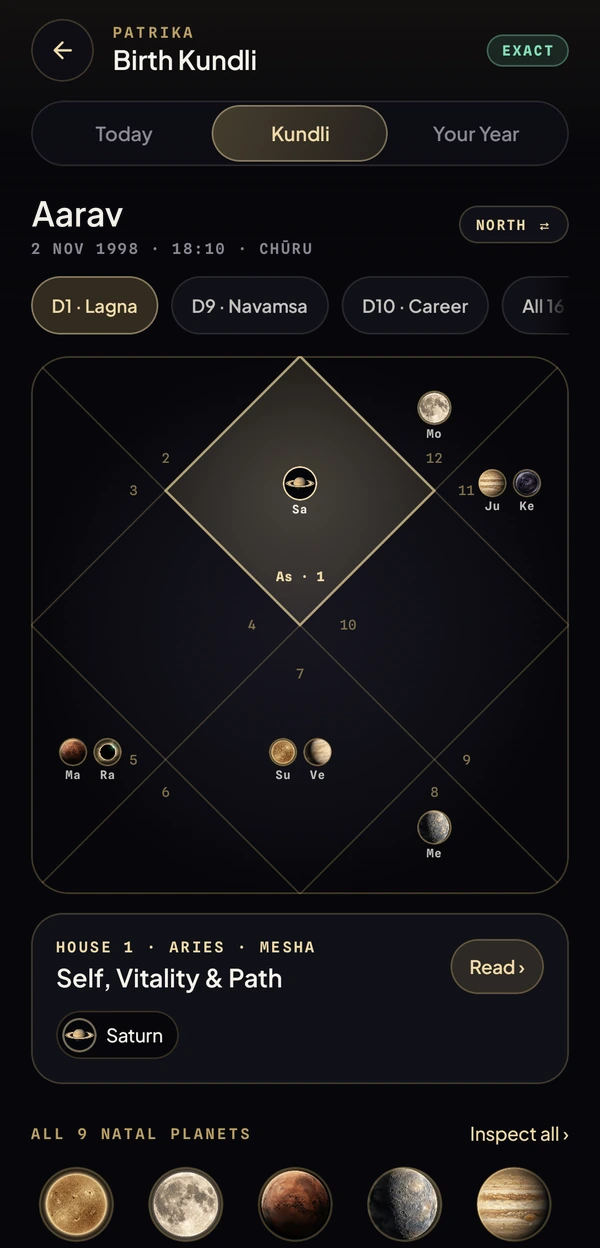
Belā app Birth Kundli showing exact North-Indian D1 Lagna chart, D9 Navamsa, D10 Career and All 16 divisional charts

Divisional Precision · D1–D16

Exact sidereal placements

North and South Indian chart layouts rendered directly from true Lahiri sidereal longitudes — Lagna, Navāṁśa (D9), Daśāṁśa (D10), and the full Ṣoḍaśavarga suite.

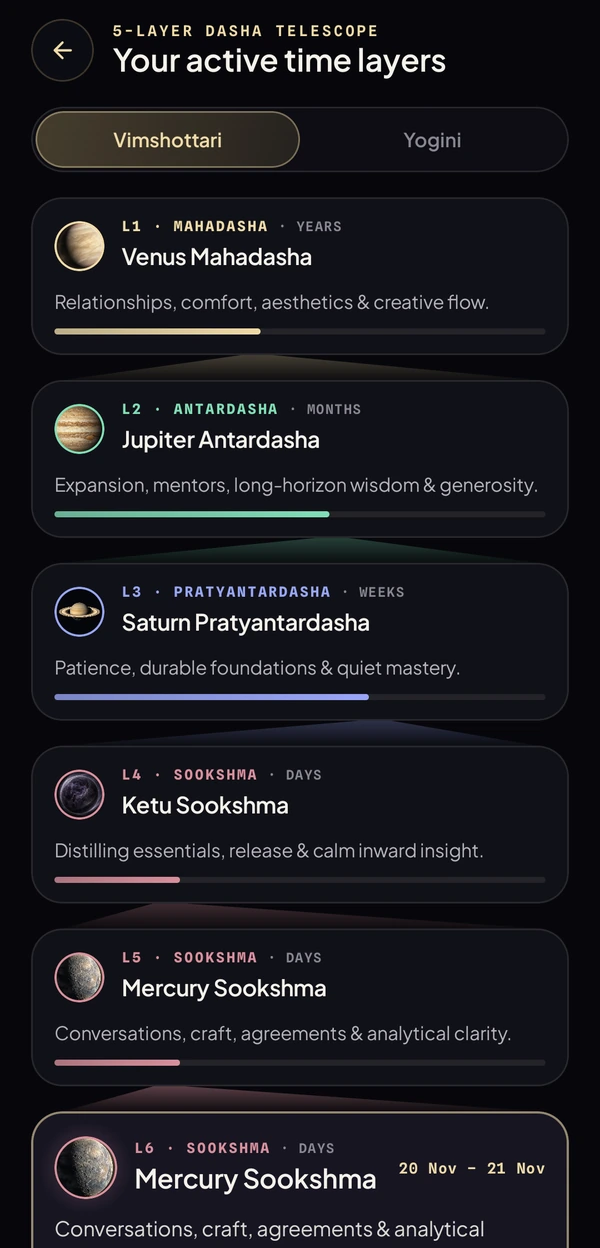
Belā app 5-Layer Dasha Telescope showing active Vimshottari Mahadasha, Antardasha, Pratyantardasha, and Sookshma layers

5-Layer Dasha Telescope

Time resolved down to the day

Vimśottarī and Yoginī periods computed from the exact natal Moon nakshatra degree — stepping cleanly from multi-year Mahādaśā down to day-level Sūkṣma shifts.

Calculation Specification

The engine

Bela is a precision instrument for sacred timing, not a content farm. The same input always produces the same answer, and the answer carries its reasoning with it.

Astronomical Ephemeris

Swiss Ephemeris (DE-Series)

Full JPL DE-series planetary files verified at process start — never approximate lookup tables or the Moshier fallback. Planetary longitudes resolve to arc-second precision.

Sidereal Coordinate Frame

Lahiri (Chitrapaksha) Ayanamsa

The reference standard of India's national calendar, frozen process-wide so no chart or muhurat can silently drift between runs. Rahu and Ketu use classical mean nodes.

Classical Ganit Convention

Drik Ganit at Local Sunrise

Tithi, nakshatra (with pada), yoga, and karana derive from true solar and lunar sidereal longitudes. Sunrise and sunset follow the Sun's upper limb with atmospheric refraction.

Geography & Reproducibility

City-Exact & Byte-Deterministic

National muhurat lists compute for Delhi (IST, 28.61°N 77.21°E); city panchang pages and personal charts recompute for exact coordinates and IANA time zones.


Electional Scoring Pipeline

How a muhurat date is chosen

For each activity the engine scans every choghadiya window of the year (16 per day) and evaluates it through four transparent classical stages:

  1. 01

    Hard Gates

    Immediate disqualification

    Every one of the day's 16 choghadiya windows is checked first against Rahu Kaal, Yamaganda, Gulika, Durmuhurtam, and the five bad Panchakas (Mrityu, Agni, Raja, Chora, Roga). Any overlap disqualifies the window.

  2. 02

    Classical Weights

    Strength accumulation

    Amrit and Shubh choghadiyas, activity-matched nakshatras (Saptadha seven-fold classification), non-rikta tithis, benign yogas, and Abhijit Muhurat add strength; harsher combinations subtract.

  3. 03

    Inclusion Floor

    Strict publication gate

    A date is published only when its strongest window clears every hard gate, its nakshatra suits the chosen activity, the tithi is not Rikta or Amavasya, and the yoga is not Vyatipata or Vaidhriti.

  4. 04

    Seasonal Prohibitions

    Traditional exclusions

    Marriage and griha pravesh exclude Chaturmas, Kharmas (Malmas), and Adhik Maasa. Vivah additionally excludes Guru and Shukra Tara Asta (combustion) and the Sun's transit through Cancer, Leo, and Virgo.

The published 0–100 score is a fixed, public mapping of the engine's internal score:

score = clamp(round((engine_score + 40) × 100 / 95), 0, 100)
70+ Auspicious40–69 ModerateBelow 40 Avoid

Every date on the muhurat pages shows the full ✓/✕/~ breakdown — that breakdown is the product, not decoration.


Honest Boundaries

What is modelled — and what is not (yet)

Trust comes from stating the boundary. Here is the honest scope of the current engine:

12Rule areas modelled
1App-only (chart-bound)
3Tracked as coming
1Stated limit
Scope of the current engine; 'Coming' items are tracked engine work, not silent omissions
AreaHow Bela treats itStatus
Panchang limbsTithi, nakshatra (with pada), yoga, karana — from true solar/lunar longitudes, evaluated at the local sunrise instant.Modelled
Rise/setSunrise/sunset when the top edge of the Sun meets the horizon (upper limb), with atmospheric refraction, per location.Modelled
Inauspicious windowsRahu Kaal, Yamaganda, Gulika, Durmuhurtam — windows overlapping them are disqualified.Modelled
ChoghadiyaAll 16 Gauri choghadiya slots per day; Amrit/Shubh/Labh/Char preferred.Modelled
PanchakaPanchaka-rahita check — Mrityu, Agni, Raja, Chora, Roga Panchakas fail the window.Modelled
Nakshatra suitabilitySaptadha (seven-fold) classification matched to each activity.Modelled
Tithi fitnessRikta tithis (4th, 9th, 14th) and Amavasya excluded.Modelled
Harsh yogasVyatipata and Vaidhriti excluded; other bad yogas flagged as caution.Modelled
Abhijit MuhuratThe universally shubh midday window adds strength (info when not hit).Modelled
Prohibited periodsChaturmas, Kharmas (Malmas) and Adhik Maasa exclude marriage and griha pravesh dates; vivah also excludes Guru/Shukra Tara Asta and the Sun's months in Cancer, Leo and Virgo.Modelled
Tara Bala / Chandra BalaJudged against your birth star — impossible for a generic list. App-tier, per profile.App feature
Shukra/Guru asta (combustion)Applied for vivah, on the Drik Panchang convention; not yet applied for other activities.Modelled
HolashtakThe 8 pre-Holi days some traditions treat as prohibited — not yet applied.Coming
Nishita windowsFestival-specific midnight/day-part puja muhurats (e.g. Shivaratri nishita) — not yet computed.Coming
Activity rules gapsVehicle, property and signing currently reuse the general rule set (the engine lacks dedicated rows); property's classical sthira-only preference is not yet applied. Flagged on the affected pages.Coming
Daylight savingEach panchang day uses its city's UTC offset in force on that date (IANA time zones), so diaspora timings follow the clock changes.Modelled
Regional calendars±1-day festival shifts across longitudes and Smarta/Vaishnava traditions are expected.Known limit

No generic list — ours included — can apply Tara Bala or Chandra Bala, which judge the day's Moon against your birth star. That needs a chart; the Bela app applies both, per family member, to every window.


Deterministic Pipeline

No LLM in the numbers, no fabricated prose

Large language models are eloquent and frequently wrong about ephemeris arithmetic. So the pipeline is strict: dates, windows, tithis and scores come only from the engine; the prose around them is authored to describe those computed facts, never to invent new ones. Site JSON is regenerated deterministically — no wall-clock stamps inside the data, and the same engine version reproduces the same files byte-for-byte.

Computation runs on a vendored, hash-pinned engine (PyJHora-class, v4.8.7, audited) — fully offline, no network calls. This site's pages are computed ahead of time, so nothing you do here reaches the engine. In the app, the birth details you enter go to our servers so the same engine can compute your chart; the privacy policy sets out what is stored and who else receives it.

Classical Provenance

Classical sources

The rule set is drawn from the standard Jyotiṣa and muhurta literature rather than invented:

  • Muhurta ChintamaniRama Daivajna

    Rahu Kaal, Panchaka-rahita, tithi and nakshatra fitness, and the prohibited periods.

  • KalaprakasikaSouth-Indian muhurta tradition

    Choghadiya practice and electional auspiciousness.

  • Brihat SamhitaVarahamihira

    The classical electional and calendrical chapters.

  • Brihat Parashara Hora ShastraSage Parāśara

    Ṣoḍaśavarga (D1–D16) divisional charts, Vimśottarī & Yoginī dashas, and natal analysis.

The Saptadha nakshatra classification and the Abhijit Muhurat follow these authorities as reflected in living panchang practice.

Where traditions differ — Smarta vs Vaishnava Ekadashi, regional calendars, Holi's Bhadra split — we follow the popular North-Indian convention for Delhi and say so on the page. We compare our 2026 and 2027 festival dates with Drik Panchang's published New Delhi list each regeneration.

Open Verification · CC BY 4.0

Verify us

The same data this site renders is downloadable — CSV and JSON, CC-BY — on the datasets page, with the per-rule breakdown included. If you find a date that fails a rule we claim it passes, that is a bug we want to hear about.

Frequently asked questions

Is Bela's muhurat data generated by an LLM?

No. Every date, window, planetary longitude and score is computed by a deterministic classical Vedic-astrology (drik ganit) engine: Swiss Ephemeris positions, Lahiri ayanamsa, mean nodes. The same input always produces the same answer. LLMs are used nowhere in the numbers pipeline — prose on data pages is authored around the computed facts.

Which ayanamsa does Bela use?

Lahiri (Chitrapaksha), the reference standard of the Indian national calendar, frozen process-wide so no computation can silently drift. Nodes are mean Rahu/Ketu, per classical practice.

Can I verify a Bela date against another panchang?

Yes — that is the point of showing the breakdown. Each published date lists its tithi, nakshatra, choghadiya and every rule verdict (Rahu Kaal ✓, Panchaka ✓, yoga ~…), so any panchang or pandit can check the same limbs. Small differences vs other sources usually trace to ayanamsa, sunrise convention, or city; ours are stated above.

What happens to my birth data in the app?

The app sends the birth details you enter to our servers, where the same vendored, hash-pinned engine computes your chart and timing. They are stored with your account, never sold or used for advertising, and erased when you delete the profile or your account. The calculators on this website need no account and send nothing about you anywhere. The privacy policy lists everything the app collects.